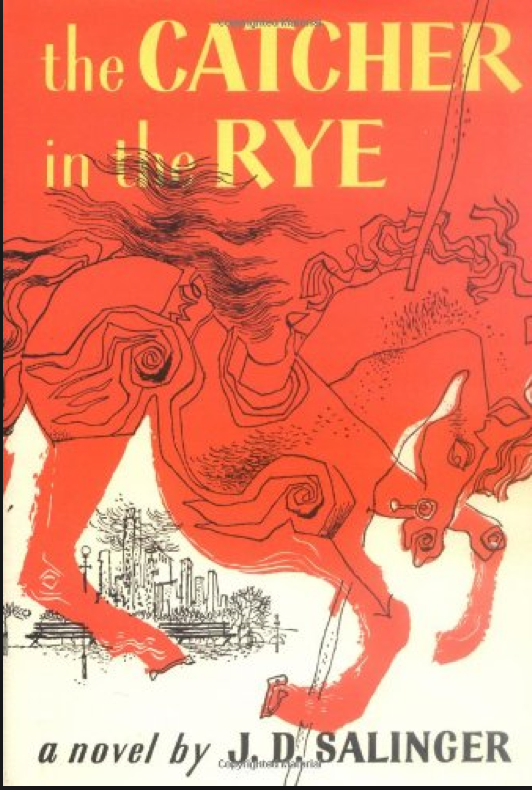
 Last evening I watched the film documentary ‘Salinger’, which is the biographical story of the very reclusive writer J.D. Salinger, author of The Catcher In The Rye. Although the film was somewhat lengthy, I found it to be an interesting account of a very complicated life. A graduate of Valley Forge Military Academy (his parents sent him there when he floundered around in local schools), Salinger went on to take some college classes in New York where he began to focus seriously on writing. But WWII changed the trajectory of his life, as it did for most young American men at that time. Right after the attack on Pearl Harbor, he was shipped off to France where he fought in the Normandy Invasion, and then in the Battle of the Bulge. Surrounded by the atrocities of war, he began to write and carried complete chapters around with him into battle. A troubled young man named Holden Caulfield was at the center of his story.
The film is worth watching, if for no other reason than to get a more complete picture of what makes a writer write. In Salinger’s case, he was considered to be a literary genius, but only after he received rejection after rejection after rejection from the publishing industry. He’d had a few things published prior to serving in the military, but he didn’t feel successful because what he really wanted was to become published in The New Yorker magazine. For Salinger, THAT was success. In all, J.D. Salinger spent ten long years writing Catcher In The Rye. When he submitted the completed manuscript for publication, his work was rejected again and again. Finally, he found a willing publisher but the offer came with a mandatory re-write, and he refused to do it. Salinger refused to allow any changes whatsoever, not even for punctuation. So he walked away. Until Little, Brown and Company came along. They agreed to publish the book EXACTLY as Salinger wrote it. The year was 1951. Over 65 MILLION copies have been sold, and over 250,000 copies continue to be purchased each year, according to the film.
I’ve begun my 2014 writing challenge, which is to complete my memoir in six months…by end of June. I have writing deadlines and accountability to a writing mentor, a woman who has taught memoir for fifteen years now, has published memoir herself. By day, she is a psychologist.
So far, I’m right on schedule with the deadlines and word count goals (actually I’ve surpassed the word count goals). Part of the requirement (class structure) is to submit 2500 words every two weeks for her review and commentary. I’ve sent in my opening chapter, with a scene that shows a tapestry of raw drama amidst family dynamics that took decades to unfurl. Now, having twice received feedback from my mentor, I’ve drawn a few conclusions…which were strengthened after watching ‘Salinger’.
I am writing my personal story. I lived it. I experienced it. My emotions as I navigated that journey are my emotions. Although feedback from a reader perspective is highly valuable and I am grateful for the guidance on outlining, scene and narrative delineation, and a host of other things, I am most intrigued by the comments from my mentor over the ‘situation’ of the story. Comments such as ‘I don’t understand how this could have happened,’ and ‘Maybe that’s just the family therapist talking here, but so far, how this came to be isn’t clear to me.’
These are comments that lead me to believe I’ve already done my job as a writer…In just the first 5000 words or so, I’ve left the reader wanting to understand how a situation like this one possibly could have happened. She is asking me, the writer, to help her understand.
If I could do that, I wouldn’t be writing a memoir. There’d be nothing really to write about. “Oh, this happened, but it makes complete sense. End of story.”
Salinger had stopped submitting for publication in 1964, becoming famously reclusive. The film quoted a phone interview that Salinger gave to a San Francisco journalist in 1974. “There is a marvelous peace in not publishing. It’s peaceful. Still. Publishing is a terrible invasion of my privacy. I like to write. I love to write. But I write just for myself and my own pleasure.”
I am writing my memoir. Whether or not the reader can neatly fit round pegs into square holes isn’t for me to instruct. Every reader has to come to their own conclusions and whether or not they approve of the ‘situation’ is irrelevant to me as a writer. I’m not writing for their approval and I’m not writing for publication. I’m writing to record the experiences that molded me into the woman I am today.
Each one of us got launched into adulthood via our own custom built springboard. My board may have had a few unexpected bounces, but that’s what memoir is. Holden Caulfield was revolutionary for a reason. He was the writer. And when it came time to submit that finished manuscript, J.D. Salinger knew that story was his, and his alone.

 Life and Other Turbulence